Browse:
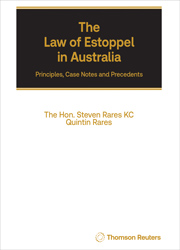
The Law of Estoppel in Australia, Principles, Case Notes and Precedents
|
eBook - ProView $330.00* RRP |
Date: 19/12/2025 Code: 9780455503721 Thomson Reuters, AUSTRALIA |
The Law of Estoppel in Australia, Principles, Case Notes and Precedents
Price: $330.00
|
Browse:
Available Formats
| Format | Title | Date | Code | Price | |
|---|---|---|---|---|---|
| Book+eBook | The Law of Estoppel in Australia - Principles, Case Notes and Precedents eBk/Bk | 19/12/2025 | 43483718 | $429.00 |
Add to cart
The Law of Estoppel in Australia - Principles, Case Notes and Precedents eBk/Bk
Price: $429.00
|
| eBook - ProView | The Law of Estoppel in Australia, Principles, Case Notes and Precedents | 19/12/2025 | 9780455503721 | $330.00 |
Add to cart
The Law of Estoppel in Australia, Principles, Case Notes and Precedents
Price: $330.00
|
| Book | The Law of Estoppel in Australia - Principles, Case Notes and Precedents | 18/12/2025 | 9780455503714 | $330.00 |
Add to cart
The Law of Estoppel in Australia - Principles, Case Notes and Precedents
Price: $330.00
|
Available Formats
Description
Estoppel in Australia is the first and only comprehensive treatment of all forms of civil estoppel in Australia.
The authors map each doctrine of estoppel in a dedicated chapter that includes a simplified overview, a thorough examination of elements, evidential requirements (including the burden of proof), case notes of the key authorities, defences, considerations for pleading and precedents of pleadings. This book distils complicated doctrines into a complete and litigation-ready guide.
Every statement of principle in the text is supported by direct quotation from one or more authorities. Every appellate decision in Australia’s history has been reviewed for the purposes of drafting this book, along with key first instance Australian decisions and all authoritative English decisions.
The co-authors of the text are a former Federal Court of Australia judge and a practising barrister.
The book is aimed at practitioners of all levels of experience and students.
The foreword of the book was drafted by the Chief Justice of Australia, the Honourable Stephen Gageler AC, the book was launched by the Chief Justice of New South Wales, the Honourable Andrew Bell AC, and the book has been reviewed in Hearsay. Extracts from each are below.
Chief Justice Gageler wrote in the foreword to the book that:
… Any practitioner who has sought to rely on an estoppel will know that the task of researching the applicable law can be long and difficult, involving trawling through reported judgments to piece together bits of a puzzle of uncertain dimensions. Often those pieces do not fit together; sometimes they are contradictory. The picture that emerges can appear distorted.
This book does much to ease those burdens. The authors have provided a dedicated chapter for each of the most common species of estoppel that arise in litigation. These are taxonomized, appropriately, into three categories. The first category comprises “litigation estoppels”, being “cause of action estoppel”, “issue estoppel” and “Anshun estoppel”. The second category comprises “common law estoppels”: “estoppel by deed”, “estoppel by representation” and “estoppel by convention”. The third comprises “equitable estoppels”, being “promissory estoppel” and “proprietary estoppel”. Each chapter provides an explanation of the distinctions and similarities between the type of estoppel compared with others, and useful summaries of the key cases of each.
The book’s even greater contribution lies in the assistance it provides on matters of practice. Each chapter outlines the precise elements of the species of estoppel with which it deals, where the burden of proof lies, what evidence is needed to establish the estoppel, and any relevant defences. In every instance, the authors have grounded the text in a comprehensive and thorough citation of authority. Practitioners can rely on what has been said. Yet the book goes further. Each chapter provides helpful observations to assist practitioners with pleading the various estoppels, even going so far as to provide precedents for pleadings in a manner that is reminiscent of Bullen & Leake’s Precedents of Pleadings [Footnote: "Now in its 19th edition: see Brennan et al, Bullen & Leake & Jacob’s: Precedents of Pleadings (Sweet & Maxwell, 2022)"].
The authors are to be congratulated for producing a comprehensive work of distinctly Australian law which is at once both scholarly and practical.
Less
Chief Justice Bell said that it is,
in my view, a really valuable and most impressive book [which] is extremely thorough and scholarly. [It] succeeds exceedingly well in its aim to be a particularly practical legal text [and that] in what will be an extremely valuable tool for practitioners, a sample pleading accompanies each chapter together with guidance as to the type of evidence needed to establish the particular variety of estoppel being described.
The full speech can be accessed here: https://supremecourt.nsw.gov.au/documents/Publications/Speeches/2026-speeches/CJ-20260504.pdf
In her review for the Queensland Bar Association’s June 2026 edition of Hearsay, Jane Muir wrote that
[t]he almost purely Australian focus of The Law of Estoppel in Australia makes it a welcome addition to the scholarship on this doctrine.
A significant “value add” for the practitioner, therefore, is the set of pleading precedents in each chapter on the estoppels that must be pleaded. The precedent application, supporting affidavit, defence (and more) are a gift, and will assist practitioners, from the start, to avoid “infelicities” in the pleadings, and in the preparing the necessary evidence…
Five stars from me.
The full review can be accessed here: https://hearsay.org.au/book-the-law-of-estoppel-in-australia-principles-case-notes-and-precedents/
Table of Contents
Introduction
Common law estoppels - litigation
Cause of action estoppel and merger
Issue estoppel
Anshun estoppel
Common law estoppels – non-litigation
Estoppel by deed
Estoppel by representation
Estoppel by convention
Equitable estoppels
Promissory estoppel
Proprietary estoppel
Some estoppels are known by more than one name. This can cause confusion. In those cases, the relevant chapter in the text includes a disambiguation section that cuts through the confusion. To be clear this book covers all the following estoppels: litigation estoppel, cause of action estoppel, merger, claim estoppel, estoppel by record, res judicata, judgment recovered, issue estoppel, Anshun estoppel, Henderson v Henderson estoppel, estoppel by deed, estoppel by writing, the technical doctrine of estoppel, estoppel by representation, estoppel in pais, estoppel by convention, conventional estoppel, estoppel by conduct, evidentiary estoppel, promissory estoppel, quasi-estoppel, High Trees estoppel, equitable estoppel, proprietary estoppel, Ramsden v Dyson estoppel, Dillwyn v Llewelyn estoppel, estoppel by acquiescence and estoppel by encouragement.
Available Formats
| Format | Title | Date | Code | Price | |
|---|---|---|---|---|---|
| Book+eBook | The Law of Estoppel in Australia - Principles, Case Notes and Precedents eBk/Bk | 19/12/2025 | 43483718 | $429.00 |
Add to cart
The Law of Estoppel in Australia - Principles, Case Notes and Precedents eBk/Bk
Price: $429.00
|
| eBook - ProView | The Law of Estoppel in Australia, Principles, Case Notes and Precedents | 19/12/2025 | 9780455503721 | $330.00 |
Add to cart
The Law of Estoppel in Australia, Principles, Case Notes and Precedents
Price: $330.00
|
| Book | The Law of Estoppel in Australia - Principles, Case Notes and Precedents | 18/12/2025 | 9780455503714 | $330.00 |
Add to cart
The Law of Estoppel in Australia - Principles, Case Notes and Precedents
Price: $330.00
|
Available Formats
Have a promo code?
Description
Estoppel in Australia is the first and only comprehensive treatment of all forms of civil estoppel in Australia.
The authors map each doctrine of estoppel in a dedicated chapter that includes a simplified overview, a thorough examination of elements, evidential requirements (including the burden of proof), case notes of the key authorities, defences, considerations for pleading and precedents of pleadings. This book distils complicated doctrines into a complete and litigation-ready guide.
Every statement of principle in the text is supported by direct quotation from one or more authorities. Every appellate decision in Australia’s history has been reviewed for the purposes of drafting this book, along with key first instance Australian decisions and all authoritative English decisions.
The co-authors of the text are a former Federal Court of Australia judge and a practising barrister.
The book is aimed at practitioners of all levels of experience and students.
The foreword of the book was drafted by the Chief Justice of Australia, the Honourable Stephen Gageler AC, the book was launched by the Chief Justice of New South Wales, the Honourable Andrew Bell AC, and the book has been reviewed in Hearsay. Extracts from each are below.
Chief Justice Gageler wrote in the foreword to the book that:
… Any practitioner who has sought to rely on an estoppel will know that the task of researching the applicable law can be long and difficult, involving trawling through reported judgments to piece together bits of a puzzle of uncertain dimensions. Often those pieces do not fit together; sometimes they are contradictory. The picture that emerges can appear distorted.
This book does much to ease those burdens. The authors have provided a dedicated chapter for each of the most common species of estoppel that arise in litigation. These are taxonomized, appropriately, into three categories. The first category comprises “litigation estoppels”, being “cause of action estoppel”, “issue estoppel” and “Anshun estoppel”. The second category comprises “common law estoppels”: “estoppel by deed”, “estoppel by representation” and “estoppel by convention”. The third comprises “equitable estoppels”, being “promissory estoppel” and “proprietary estoppel”. Each chapter provides an explanation of the distinctions and similarities between the type of estoppel compared with others, and useful summaries of the key cases of each.
The book’s even greater contribution lies in the assistance it provides on matters of practice. Each chapter outlines the precise elements of the species of estoppel with which it deals, where the burden of proof lies, what evidence is needed to establish the estoppel, and any relevant defences. In every instance, the authors have grounded the text in a comprehensive and thorough citation of authority. Practitioners can rely on what has been said. Yet the book goes further. Each chapter provides helpful observations to assist practitioners with pleading the various estoppels, even going so far as to provide precedents for pleadings in a manner that is reminiscent of Bullen & Leake’s Precedents of Pleadings [Footnote: "Now in its 19th edition: see Brennan et al, Bullen & Leake & Jacob’s: Precedents of Pleadings (Sweet & Maxwell, 2022)"].
The authors are to be congratulated for producing a comprehensive work of distinctly Australian law which is at once both scholarly and practical.
Less
Chief Justice Bell said that it is,
in my view, a really valuable and most impressive book [which] is extremely thorough and scholarly. [It] succeeds exceedingly well in its aim to be a particularly practical legal text [and that] in what will be an extremely valuable tool for practitioners, a sample pleading accompanies each chapter together with guidance as to the type of evidence needed to establish the particular variety of estoppel being described.
The full speech can be accessed here: https://supremecourt.nsw.gov.au/documents/Publications/Speeches/2026-speeches/CJ-20260504.pdf
In her review for the Queensland Bar Association’s June 2026 edition of Hearsay, Jane Muir wrote that
[t]he almost purely Australian focus of The Law of Estoppel in Australia makes it a welcome addition to the scholarship on this doctrine.
A significant “value add” for the practitioner, therefore, is the set of pleading precedents in each chapter on the estoppels that must be pleaded. The precedent application, supporting affidavit, defence (and more) are a gift, and will assist practitioners, from the start, to avoid “infelicities” in the pleadings, and in the preparing the necessary evidence…
Five stars from me.
The full review can be accessed here: https://hearsay.org.au/book-the-law-of-estoppel-in-australia-principles-case-notes-and-precedents/
Table of Contents
Introduction
Common law estoppels - litigation
Cause of action estoppel and merger
Issue estoppel
Anshun estoppel
Common law estoppels – non-litigation
Estoppel by deed
Estoppel by representation
Estoppel by convention
Equitable estoppels
Promissory estoppel
Proprietary estoppel
Some estoppels are known by more than one name. This can cause confusion. In those cases, the relevant chapter in the text includes a disambiguation section that cuts through the confusion. To be clear this book covers all the following estoppels: litigation estoppel, cause of action estoppel, merger, claim estoppel, estoppel by record, res judicata, judgment recovered, issue estoppel, Anshun estoppel, Henderson v Henderson estoppel, estoppel by deed, estoppel by writing, the technical doctrine of estoppel, estoppel by representation, estoppel in pais, estoppel by convention, conventional estoppel, estoppel by conduct, evidentiary estoppel, promissory estoppel, quasi-estoppel, High Trees estoppel, equitable estoppel, proprietary estoppel, Ramsden v Dyson estoppel, Dillwyn v Llewelyn estoppel, estoppel by acquiescence and estoppel by encouragement.
Contract Law