Thomson Reuters ProView™ is the intuitive eReader for law and tax professionals. Access trusted content via your browser online, and experience peerless mobility, speed and customisation choice.
Fact finding is ubiquitous in the law. It is also the most consequential feature of most litigation. Yet despite its prevalence and importance, it has rarely been the subject of sustained legal analysis or exposition.
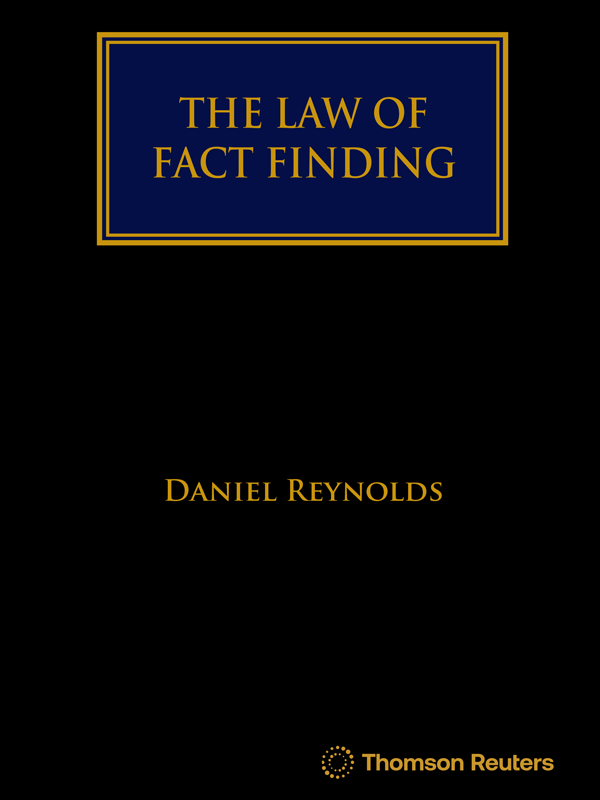
The Law of Fact Finding addresses that absence by providing, for the first time in the common law world, a comprehensive account of this vast subject. The book sets out the legal rules and principles which govern the exercise of fact finding and which place hard outer limits on what is permissible in the performance of that exercise.
The Law of Fact Finding contains the following chapters:
1. Introduction 2. Ends and means of fact finding 3. General principles of fact finding 4. The onus of proof 5. Standards of proof 6. Presumptions 7. Counterfactuals 8. Constitutional facts 9. Challenging facts on appeal 10. Fact finding by administrative decision-makers 11. Fact finding in criminal proceedings 12. Alternative fact-finding procedures
The book addresses a number of vexing questions including: What rules facilitate and constrain the making of findings of fact? Where does the onus of proof lie in a novel case? To which facts does it apply? When is a presumption engaged, and what is its effect? How are counterfactual facts to be found? What rules govern the finding of constitutional facts? How may findings be challenged on appeal? How can fact finding of an administrative decision-maker be impugned in judicial review proceedings? Does the irrationality ground of judicial review apply only the ultimate outcome of a decision-maker’s consideration, or to reasoning and findings of fact made as steps along the way to that outcome? What is required of a sentencing judge in ensuring that their findings are not inconsistent with the jury’s verdict?
In the foreword to the book, the Chief Justice of Australia, the Honourable Stephen Gageler AC, noting the lack until now of a systematic account of the legal principles that govern the law of fact finding, wrote as follows:
"This splendid book on the law of fact finding provides that hitherto missing account. It fills a void in the secondary legal literature so vast as to have not previously been recognised to exist. Thoroughly researched, carefully structured and clearly written, it is destined to become a standard work of reference".
The book is intended to be practical and propositional. Its primary intended audience is Australian legal practitioners and judges. As such, it seeks to state the content of the law as it applies in Australia, albeit with reference to English authority where relevant.
__PRESENT
Got a Promo Code?
Enter an offer code
Applying promo...
Coupon code is invalid. Please verify the code and try again.
Thomson Reuters ProView™ is the intuitive eReader for law and tax professionals. Access trusted content via your browser online, and experience peerless mobility, speed and customisation choice.
Fact finding is ubiquitous in the law. It is also the most consequential feature of most litigation. Yet despite its prevalence and importance, it has rarely been the subject of sustained legal analysis or exposition.
The Law of Fact Finding addresses that absence by providing, for the first time in the common law world, a comprehensive account of this vast subject. The book sets out the legal rules and principles which govern the exercise of fact finding and which place hard outer limits on what is permissible in the performance of that exercise.
The Law of Fact Finding contains the following chapters:
1. Introduction 2. Ends and means of fact finding 3. General principles of fact finding 4. The onus of proof 5. Standards of proof 6. Presumptions 7. Counterfactuals 8. Constitutional facts 9. Challenging facts on appeal 10. Fact finding by administrative decision-makers 11. Fact finding in criminal proceedings 12. Alternative fact-finding procedures
The book addresses a number of vexing questions including: What rules facilitate and constrain the making of findings of fact? Where does the onus of proof lie in a novel case? To which facts does it apply? When is a presumption engaged, and what is its effect? How are counterfactual facts to be found? What rules govern the finding of constitutional facts? How may findings be challenged on appeal? How can fact finding of an administrative decision-maker be impugned in judicial review proceedings? Does the irrationality ground of judicial review apply only the ultimate outcome of a decision-maker’s consideration, or to reasoning and findings of fact made as steps along the way to that outcome? What is required of a sentencing judge in ensuring that their findings are not inconsistent with the jury’s verdict?
In the foreword to the book, the Chief Justice of Australia, the Honourable Stephen Gageler AC, noting the lack until now of a systematic account of the legal principles that govern the law of fact finding, wrote as follows:
"This splendid book on the law of fact finding provides that hitherto missing account. It fills a void in the secondary legal literature so vast as to have not previously been recognised to exist. Thoroughly researched, carefully structured and clearly written, it is destined to become a standard work of reference".
The book is intended to be practical and propositional. Its primary intended audience is Australian legal practitioners and judges. As such, it seeks to state the content of the law as it applies in Australia, albeit with reference to English authority where relevant.

 Administrative Law