Saving: $188.40
|
Book $125.60* $314.00 RRP Save: $188.40 (60%) |
Date: 25/05/2011 Code: 9780455229317 Lawbook Co., AUSTRALIA |
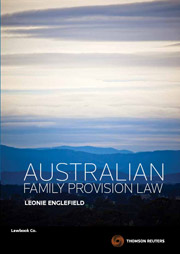
Australian Family Provision Law
Sale Price: $125.60
Saving: $188.40 |
| Format | Title | Date | Code | Price | |
|---|---|---|---|---|---|
| Book | Australian Family Provision Law | 25/05/2011 | 9780455229317 | $125.60 |
Add to cart
Australian Family Provision Law
Sale Price: $125.60
Saving: $188.40 |

Book
$290.00 $116.00

Book+eBook
$377.00 $150.80

eBook - ProView
$290.00 $116.00

eSub - ProView
N/A

Looseleaf
N/A
From: The Law Society of Tasmania
Reviewed by: Anita Brunacci
This book deals with Family Provisions within a person’s estate for all Australian jurisdictions. In Tasmania the relevant legislation is the Testator’s Family Maintenance Act 1912.
Each jurisdiction receives a well structured commentary of relevant considerations and in regard to NSW the book deals with both the old and new legislation.
Each State and Territory’s legislation is outlined and relevant provisions are replicated in full to give the reader an excellent reference point from which to work. This includes references to time limits and considerations of the Court for a successful claim.
For those who do not regularly practice in this area or who receive an enquiry which they wish to refer on the book also has precedent “client intake forms” which allows clients to begin locating required material before their first appointment and turning their mind to what sort of information they will need to know.
Having never worked in this area of law previously I found this book to be an excellent practitioner’s guide with sections devoted to the considerations to be taken into account when assessing a client’s right and / or ability to claim. A summary of the practical nature of the book can be found in its eight section headings, which are:
1. General overview of the scheme
2. Eligible Applicants
3. Relevant factors
4. Practice procedure, a step by step guide to the Court process
5. What the Estate comprises (what can be claimed against)
6. Orders which can /should be sought
7. Time limits
8. Superannuation issues
This book should be considered a must read for someone who desires a basic overview of the area to assist in understanding the legislation in any Australian jurisdiction and the underpinning considerations which are raised as to the importance of Family Provisions in Will’s and Estate Planning.
This book could also be used as a valuable resource for quick reference on time limits in each jurisdiction as, with the cultural increase of traveling and relocation the chances of needing to give advice in this area in relation to other jurisdictions is continually increasing and, along with assessing the right to claim, practitioners need to ensure the advice is given in a timely fashion so that it is still relevant to the client.
| Format | Title | Date | Code | Price | |
|---|---|---|---|---|---|
| Book | Australian Family Provision Law | 25/05/2011 | 9780455229317 | $125.60 |
Add to cart
Australian Family Provision Law
Sale Price: $125.60
Saving: $188.40 |

Book
$290.00 $116.00

Book+eBook
$377.00 $150.80

eBook - ProView
$290.00 $116.00

eSub - ProView
N/A

Looseleaf
N/A
From: The Law Society of Tasmania
Reviewed by: Anita Brunacci
This book deals with Family Provisions within a person’s estate for all Australian jurisdictions. In Tasmania the relevant legislation is the Testator’s Family Maintenance Act 1912.
Each jurisdiction receives a well structured commentary of relevant considerations and in regard to NSW the book deals with both the old and new legislation.
Each State and Territory’s legislation is outlined and relevant provisions are replicated in full to give the reader an excellent reference point from which to work. This includes references to time limits and considerations of the Court for a successful claim.
For those who do not regularly practice in this area or who receive an enquiry which they wish to refer on the book also has precedent “client intake forms” which allows clients to begin locating required material before their first appointment and turning their mind to what sort of information they will need to know.
Having never worked in this area of law previously I found this book to be an excellent practitioner’s guide with sections devoted to the considerations to be taken into account when assessing a client’s right and / or ability to claim. A summary of the practical nature of the book can be found in its eight section headings, which are:
1. General overview of the scheme
2. Eligible Applicants
3. Relevant factors
4. Practice procedure, a step by step guide to the Court process
5. What the Estate comprises (what can be claimed against)
6. Orders which can /should be sought
7. Time limits
8. Superannuation issues
This book should be considered a must read for someone who desires a basic overview of the area to assist in understanding the legislation in any Australian jurisdiction and the underpinning considerations which are raised as to the importance of Family Provisions in Will’s and Estate Planning.
This book could also be used as a valuable resource for quick reference on time limits in each jurisdiction as, with the cultural increase of traveling and relocation the chances of needing to give advice in this area in relation to other jurisdictions is continually increasing and, along with assessing the right to claim, practitioners need to ensure the advice is given in a timely fashion so that it is still relevant to the client.